| UTU Daily News Digest |
Information of interest
to operating railroad and transportation employees
Thursday, January 7, 1999
Amtrak's speedy new tilt trains a bit too wide
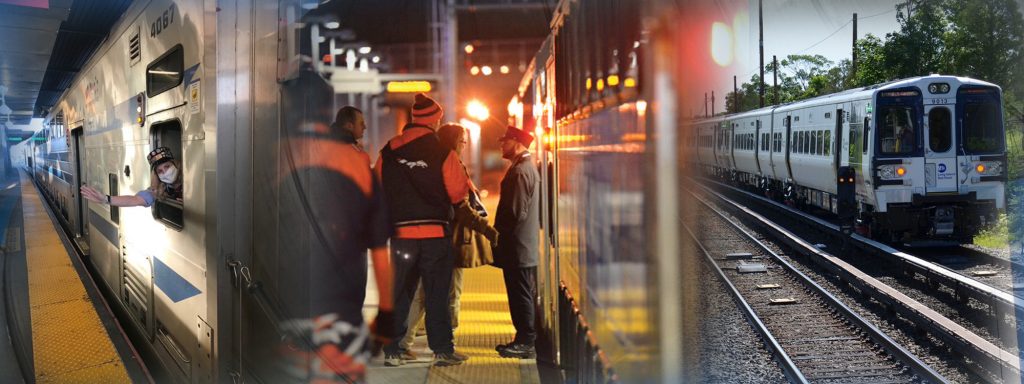
WASHINGTON -- Amtrak's new 150-mph tilt trains, designed to bring a new level of speed and smoothness to the Washington-Boston corridor late this year, were built four inches too wide and will be unable to go around some curves as fast as planned, Amtrak and the Federal Railroad Administration officials confirmed yesterday, the Washington Post reported.
The previously undisclosed problem means that Amtrak will have to speed up as much as $12 million in track and clearance projects in order to maintain a new three-hour express schedule between New York and Boston promised under the $710 million contract for the trains. Sharp curves now hold the route's time to about 4 1/2 hours.
David J. Carol, Amtrak's vice president for high-speed rail, said "there may well be legal issues" with the manufacturer, Bombardier Inc. of Montreal, but the project will not be delayed.
Kim Fisher, a spokeswoman for Bombardier, said the company is mystified by Amtrak's and U.S. government officials' belief that there is a problem. She said Bombardier believes it has met specifications, and simulations show that a somewhat wider car body "will have no effect on trip time."
The contract, announced with great fanfare by Vice President Gore in 1996, calls for 20 train sets consisting of two locomotives, four coaches, a dining car and a first-class car. With a higher speed and a tilt on curves for passenger comfort, the new train sets will replace current 125-mph Metroliner equipment between Washington and New York, allowing a two-hour-45-minute schedule.
Although the New York-Washington times are only 14 minutes faster than current times, the new sets are expected to ride far smoother than the current cars, which can be somewhat bumpy. By far the most improved trip times will be on the curvy New York-Boston route.
The Washington Post reported that Carol said Amtrak officials discovered the width problem after most of the train sets were under construction. He said the first indication of the problem arose in April 1997.
The problem, he said, is that with the extra four inches, the train cannot tilt the planned 6.5 degrees maximum without violating what he called the "clearance envelope." Under what is essentially a disaster scenario, there must be enough room between adjacent tracks that two passing trains could have a total suspension breakdown and lean the wrong way while still passing safely.
Carol said that with the extra width, the cars can tilt only 4.2 degrees and still meet clearance specifications.
How the problem arose remains a mystery. Bombardier says there is no problem, and Carol said Amtrak cannot determine why because Bombardier is being uncooperative.
"Bombardier has never been particularly candid with us about how this happened," he said. For now, he said, both sides have decided to move ahead with keeping the project on schedule.
One locomotive is undergoing testing at the Association of American Railroads test center in Pueblo, Colo., and no problems have been found necessitating any basic design changes. Full train-set endurance tests are scheduled to begin in May on the Washington-Boston corridor, and regular service is scheduled to be phased in beginning in October.
Carol disputed several railroad industry sources who said the problem would add 20 minutes to the New York-Boston schedule. He said that estimate probably did not take into account recent improvements on the route. He also said that Amtrak planners had found 10 to 15 minutes of unnecessary padding in planned schedules, for such assumptions as trains being stopped for three minutes before being allowed to enter tunnels into Manhattan.
"All else being equal, this [the extra width] will have a three-minute trip-time impact," he said.
Amtrak now plans to accelerate other projects that would allow increased speeds. He said in particular the company is discussing higher speeds with the commuter authority Metro North, which owns the tracks between New Haven, Conn., and New Rochelle, N.Y. With a 90-mph track speed limit, this is the slowest stretch of the New York-Boston run. Carol said he believes a 110-mph speed is possible, the Washington Post said.
Carol also said improvement to the massive Hell Gate Bridge in Queens, N.Y., could raise the speed limit there to 90 mph from 60 mph. A faster trip through tunnels into New York Penn Station is also possible, he said.
After Amtrak gains more experience with the tilt mechanism, Carol said it may also be possible to allow faster speeds over portions of the line.
A Federal Railroad Administration official, who did not want to be named, said he is "comfortable" that Amtrak will begin running the train sets on time, and "will be able to meet its revenue and trip-time goals."
The new Bombardier train will be based on the French TGV design, with a tilt mechanism added to allow the trains to lean into curves. This tilt is mainly for passenger comfort. Current trains could go much faster around curves, but passengers would be thrown against walls.
Under Amtrak specifications, passengers may be subjected to no more than one-tenth the force of gravity in side-to-side, or lateral motion.
Each train will haul up to 304 passengers. Each seat will have a 120-volt outlet for computers, and extra-large tray tables for computers and power packs. The first-class and dining cars will have video entertainment, and all seats will have audio entertainment.
Carol noted that even the four inches of extra width adds an unexpected advantage.
"We'll have wider seats and aisles," he said. "Frankly, that's attractive."
Clinton announces Burke appointment to STB
WASHINGTON -- The President Wednesday announced his intent to nominate Wayne O. Burkes to serve as Member of the Surface Transportation Board (STB).
Burkes, of Jackson, Mississippi, has served as Central District Commissioner for the Mississippi Department of Transportation since 1989. He served in the Mississippi Legislature, four years in the House of Representatives and ten years in the Senate and served on the Highways and Transportation Committees for all 14 years. Burkes served in the U.S. Air Force and the Mississippi Air National Guard for 38 years, reaching the level of Major General from 1986 until his retirement in 1989.
Burkes received his B.S., M. Ed., and LL.D. degrees from Mississippi College and a M. Div. Degree from the New Orleans Baptist Theological Seminary.
The Surface Transportation Board (STB), a bipartisan board, was created in 1995 and began its existence in January 1996 as the successor to the former Interstate Commerce Commission (ICC), with curtailed regulatory powers focused primarily on the railroad industry.
Alameda Corridor gets Wall Street support
LOS ANGELES -- The Alameda Corridor has the endorsement of three Wall Street firms, which have issued strong ratings for the $1.2 billion in bonds to complete its financing.
The Alameda Corridor Transportation Authority bonds are scheduled to be sold during the week of Jan. 18. They will finance about half of the $2.4 billion corridor. The remainder has been committed by federal, state and local sources.
The project will consolidate intermodal rail traffic in Southern California into a 20-mile corridor connecting the Los Angeles-Long Beach port complex to intermodal rail transfer yards near downtown Los Angeles.
The corridor will eliminate 200 grade crossings from existing routes operated by the Union Pacific Railroad and the Burlington Northern and Santa Fe Railway. Fitch Investors Services gave the $1 billion in senior bonds an "A" rating. Moody's Investors Service gave them an "A2" rating, which is the equivalent of the Fitch rating; Standard and Poor's gave the senior debt a "BBB-plus" rating.
"These are well above investment-grade ratings, as they should be," said Jim Preusch, chief financial officer at the Port of Los Angeles.
The bond indebtedness will be financed by user fees from the two Class One railroads that will use the Alameda Corridor -- the UP and the BNSF.
The rail carriers will pay $15 per TEU for loaded containers, $4 per TEU for empties, $8 per car for other types of rail cars and $4 per empty rail car.
The bond sale will include $170 million in subordinate lien debt, which received a slightly lower rating because those bondholders would not be paid if there are cash flow problems until the senior lien bondholders are paid.
The ports of Los Angeles and Long Beach will provide additional financial security through a shortfall provision that will obligate each port to cover up to 20% of the Alameda Corridor Transportation Authority's debt obligations should cash flow be inadequate at any time while the bonds are being paid off.
The ports project that they may have to make some cash payments for 10 to 12 years after the corridor is completed in 2002. The ports believe, however, their contribution period will be shorter because projections of cargo flows through the Southern California port complex have always underestimated the container volume that was actually handled.
U.S. ports, and especially those on the West Coast, are becoming increasingly dependent upon intermodal cargo. Intermodal freight, also known as discretionary cargo, is highly competitive. On the West Coast, the major load centers of Los Angeles-Long Beach, Oakland and Seattle-Tacoma compete aggressively.
In order to compete, the three load centers must minimize the bottlenecks that slow the movement of intermodal cargo from the ports to the transcontinental rail and highway networks. In its analysis of the bond sale and the ability of the Alameda Corridor Transportation Authority and the ports to pay the debt service, Moody's noted that consolidation in the shipping industry is driving the trend toward large load center ports.
About 50% of the more than 7 million 20-foot container units that move through the Los Angeles-Long Beach port complex each year continue on by rail to the eastern half of the country.
CPR to discontinue operations on Saskatchewan rail line
CALGARY -- Service on a 104-km (65-mile) rail line in southern Saskatchewan, between Ogle and Mankota, was discontinued Wednesday by Canadian Pacific Railway (CPR), in accordance with the Canada Transportation Act (CTA), the railway announced.
Attempts by the railway to find private-sector or government buyers for the line have not succeeded.
On April 1, 1997, CPR announced the line, the Wood Mountain Subdivision, was a candidate for discontinuance under its three-year network plan. In recent years, traffic on the line has been steadily declining.
The line was offered for sale in January 1998 to the shortline marketplace and then, last September, to the provincial and municipal governments. CPR was engaged in extensive discussions until recently with a local group that had expressed interest in the line.
BTS pocket guide traces transportation trends
WASHINGTON -- The U.S. Department of Transportation's Bureau of Transportation Statistics (BTS) today released a new edition of its popular Pocket Guide to Transportation.
"This small publication contains a wealth of information on a wide variety of transportation subjects, and illustrates major transportation trends over the past 26 years," said Dr. Ashish Sen, the Bureau's new director. "This information will be helpful to all involved in making America's transportation system safe, reliable and efficient for the 21st century."
One of the trends Dr. Sen cited is the near doubling of long-distance trips within the United States between 1977 and 1995.
The Pocket Guide to Transportation is divided into four sections, which cover the extent and use of the American transportation network, the impact of transportation on the economy, safety information, and energy and environmental issues. Much of the information parallels that contained in more detail in the Bureau's Transportation Statistics Annual Report 1998.
To order free copies of the Pocket Guide to Transportation, call (202) 366-DATA (3282), fax (202) 366-4640, or write the Bureau of Transportation Statistics, U.S. Department of Transportation, Room 3430, 400 Seventh Street, SW, Washington, DC 20590. The electronic version of this report is available on the BTS Internet site, www.bts.gov.
UTU Home Page | UTU Daily News Main Page
Copyright © 1998 United Transportation Union
Last modified: May 09, 2001