| UTU Daily News Digest |
Information of interest
to operating railroad and transportation employees
Tuesday, March 2, 1999
Senate subcommittee to review STB status today
WASHINGTON Among the issues before the Senate Surface Transportation and Merchant Marine Subcommittees hearing today is the reauthorization of the Surface Transportation Board (STB).
James Brunkenhoefer, national legislative director of the United Transportation Union, and Ed Wytkind, director of the Transportation Trades Department of the AFL-CIO, will present union views.
It will be the first formal congressional review of key rail issues in the current session after attempts last year to reauthorize STB were unsuccessful.
The hearing will tackle broader policy issues because the witnesses include three shipper representatives, two union officials, STB Chairman Linda Morgan and rail trade association leader Edward Hamberger.
From the shipper side, representatives will include: National Industrial Transportation League President Edward Emmett; John Bratten, vice president of Central Soya Co. of Fort Wayne, Ind.; and Bill Harvey, a vice president at Lyondell Petrochemical of Houston.
Mr. Laur is appearing on behalf of the National Grain and Feed Association, which signed an agreement with the railroads last year to arbitrate some rate and service disputes.
NIT League comes to the hearing after meeting six weeks ago with AAR to discuss a possible compromise on competitive issues. Additional meetings between these groups are expected.
Mr. Harvey represents the Alliance for Rail Competition, a coalition of groups that are seeking legislation to create additional rail competition as part of the reauthorization process.
Shippers cite hurdles in seeking relief for rail costs
WASHINGTON -- A process that shippers find expensive and burdensome keeps them from seeking federal recourse even when they believe railroads are charging too much, according to congressional auditors.
A report by the General Accounting Office, being released today at a Senate hearing, shows that large numbers of rail shippers feel they are systematically being overcharged by rail carriers who have monopolies in their region. But at the same time, a majority believes federal regulators don't provide accessible relief.
The federal agency in charge of fielding complaints about rates -- the Surface Transportation Board -- has a process that seems too complicated and unwieldy for many shippers to undertake, according to the report by the GAO, the investigative arm of Congress.
"The process of providing rate relief is so expensive and so cumbersome that it is almost unworkable," says Sen. Byron Dorgan. D.N.D., one of the lawmakers who requested the report. "When shippers are held captive by a monopoly, they don't have an effective way to complain."
More than 75 percent of the 700 shippers surveyed by GAO auditors said they are paying unreasonable rates for rail service. And 70 percent said the time, complexity and costs in filing complaints with the STB are barriers that often preclude them from seeking relief.
For example, the GAO said, shippers who file a complaint that a railroad is using its market dominance to overcharge must create a model for the STB, demonstrating how much an optimally efficient railroad should charge.
Nearly 72 percent of shippers told the GAO that constructing such a model is a difficult task, particularly for small businesses. "The time and cost associated with the model's development may outweigh the compensation afforded the shipper should the board determine that the challenged rate was unreasonable," GAO said.
The auditors tracked the 41 complaints filed with the STB since 1990 and found that shippers spent about $500,000 to $3 million preparing each case. The process can also be timely -- with the STB taking anywhere from several months to, in one instance, 16 years to resolve a case.
The report was to be introduced today as an exhibit in a Senate subcommittee hearing on reauthorizing the Surface Transportation Board.
Dorgan said the GAO study will give the surface transportation and Merchant Marine subcommittee of the Senate Commerce Committee "a road map" in determining what changes are needed at the agency.
"Especially in a period when you have so many railroad mergers, you either need effective regulation or a complaint process that is simple," Dorgan said. He stressed that extra costs are eventually passed down to farmers and small businesses.
In a separate survey, the GAO interviewed the nine major freight railroads. They expressed satisfaction with the rate review process and said no change in the process is necessary.
The board has implemented some measures to streamline its complaint process, the GAO said. For example, it eliminated product and geographic competition as criteria for determining market dominance by a railroad. It also has implemented guidelines to simplify complaints involving smaller dollar amounts.
A second GAO report analyzing the rates shippers pay freight railroads is scheduled for release in April.
Jurors award $29.6 million to violinist injured by train
CHICAGO -- Four years after an awful day that changed her life, a jury decided that prize-winning violinist Rachel Barton was due $29.6 million for the train accident that cost her a leg and part of a foot.
Barton, 24, was dragged 366 feet down the tracks from a suburban Winnetka commuter platform after the strap of her violin case caught in a closing door in 1995. She sued Metra, the commuter rail agency, and the Chicago and Northwestern Transportation Co., now owned by Union Pacific.
Barton claimed that the strap pinned her. Railroad attorneys said she kept on clutching the strap because her 200-year-old Amati violin was worth $500,000. Barton said it's time to move on.
"In the end, as it was in the beginning of this terrible journey, I hope to be known for my music and not my injuries," she told reporters.
Railroad attorney C. Barry Montgomery said the award was far too high.
"People relate to the Michael Jordans of the world and the enormous amounts being spent in the movie industry and when that carries over into the jury box, that is a serious thing," he said.
Montgomery also said that the jurors -- some of whom hugged Barton and kissed her on the cheek as they left the courthouse -- seemed to be swayed by sympathy for her condition rather than the facts of the case. Barton, who uses crutches or a wheelchair and has a prosthetic left leg, told jurors, "I'm just one big Frankenstein monster," in describing her injuries.
In closing arguments, Barton attorney Robert Clifford called the accident "an event waiting to happen." He pointed to 14 riders who have been pinned between train doors in similar circumstances over the last five years. Railroad attorneys noted that none of the 14 were seriously hurt.
Barton in 1992 became the first American and the youngest person ever to win first prize in the Bach Competition in Leipzig, Germany. She was the only American laureate of the 1993 Queen Elizabeth Competition in Brussels. She also has performed with the Chicago Symphony Orchestra and the Chicago Lyric Opera Orchestra.
Amtrak resumes service after mudslides
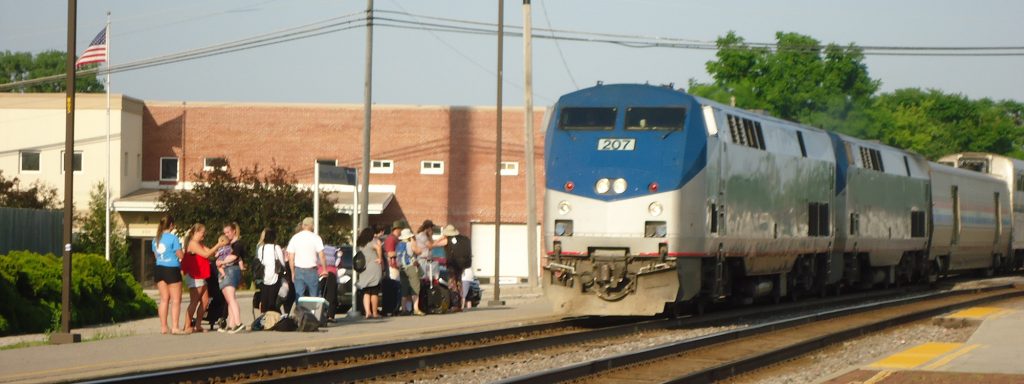
SEATTLE -- Amtrak service is back to normal after heavy mudslides forced the cancellation of passenger runs. Travelers were bused between Everett, Seattle and Portland after heavy rains caused mud to block tracks last week. Now, all tracks north and south of Seattle have been cleared.
STB swears in two new members
WASHINGTON -- Surface Transportation Board (Board) Chairman Linda J. Morgan announced that Wayne Burkes and that William Clyburn, Jr., have been sworn in as new members.
Commissioner Burkes, a Republican from Mississippi, was recommended for service on the Board by Senate Majority Leader Trent Lott, was nominated to the Board by President Clinton, and was confirmed by the Senate on February 22, 1999, for a term expiring December 31, 2002.
Commissioner Burkes is a native of Mississippi with a distinguished career in the military, public service, and private sectors. Prior to joining the Board, Commissioner Burkes served as Transportation Commissioner of Mississippi's Central District, since March 1989. Before being elected Commissioner, he served four years in the Mississippi House of Representatives and ten years in the Senate. Commissioner Burkes served on Mississippi's Highways and Transportation Committees for the 14-year duration of his legislative experience.
Burkes received his B.S., M.Ed., and LL.D. degrees from Mississippi College, and a M.Div. Degree from the New Orleans Baptist Theological Seminary. He is also a graduate of the Industrial College of the Armed Forces, the Air University's Air War College, and the Transportation Executive Institute of the University of Virginia. A longtime Air Force and Air National Guard pilot, Burkes has flown eight different Air Force aircraft for 7,000 flying hours and is a retired Major General from the Mississippi Air National Guard.
Vice Chairman Clyburn, a Democrat from South Carolina, was nominated to the Board on September 2, 1997, by President Clinton and began service December 21, 1998, through a Presidential recess appointment on December 18, 1998, (see Surface Transportation Board "News" release No. 98-87 issued December 28, 1998). President Clinton subsequently resubmitted the Vice Chairman's nomination in the 106th Congress, and the United States Senate confirmed his nomination on February 22, for a term to expire on December 31, 2000.
Canada rail freight down 5.9% in week to Feb. 7
OTTAWA -- Canadian rail freight volume, excluding intermodal traffic, totaled 4.6 million metric tons in the week ended Feb. 7, down 5.9% from a year earlier, Statistics Canada said.
The number of rail cars loaded during the week declined 3.4% from a year earlier. Intermodal (piggyback) volume totaled 361,000 tons in the week, up 14.2% from a year earlier.
Total traffic in the week, including carloadings of freight and intermodal traffic, declined 4.7% from a year earlier. For the year to date, traffic totaled 23.7 million tons, down 6.5% from a year earlier.
Roanoke residents fight to keep rail crossing
ROANOKE, Texas -- Union Pacific Railroad wants to close a railroad crossing to make it easier to push through a new rail line for Ross Perot Jr.'s Alliance Gateway development, but nearby residents and business owners say the closure would cut off their neighborhood from the rest of town.
Closing the Gin Road crossing to traffic is a public safety issue, according to some of the six families and five businesses in the neighborhood west of the railroad tracks.
The crossing is one of two nearby exits from the neighborhood. When the crossing is blocked by a train, Roanoke residents west of the railroad tracks sometimes have to travel a circuitous route that can add 20 minutes to a two-minute trip, said Gin Road resident and business owner Edwin Peterson. Benson Lane, which intersects Gin Road at the crossing, leads to a second railroad crossing.
"If we have a fire, an emergency, not only can we not get out, emergency crews can't get in. It's a battle now. ...," Peterson said. "If they take a crossing out and put in another line, we'll be at the mercy of the trains, and they don't have any mercy."
Perot's Hillwood Development Corp. is paying for the rail line, which will serve Alliance Gateway tenant DSC Logistics, an Illinois-based storage and distribution company that is building a 600,000-square-foot distribution facility. The line could also be extended to serve other tenants that move into Alliance Gateway's north section, said David Pelletier, Hillwood's director of communications.
Hillwood also offered to pay for more than $300,000 in improvements to Benson Lane, which is in need of extensive repairs, if the Roanoke City Council would approve closing the crossing.
But the council last week rejected the request to close the Gin Road crossing, citing confusion as to whether Roanoke owns the two streets west of the railroad tracks. Dewayne Roberts, owner of Roanoke Self-Storage, said he owns Gin Road and has the paperwork to prove it.
Whether Gin Road and Benson Lane are public streets or privately owned and whether Union Pacific has an easement that might allow it to close the Gin Road crossing without the city's permission are questions the city needs answered, Roanoke City Manager Jimmy Stathatos said.
Roanoke and Hillwood officials said they see the matter as a dispute between Union Pacific and private landowners, although Stathatos said the city will try to bring the sides together.
"We're still very interested in perhaps being a broker in this and an information gatherer," Stathatos said.
Parties in the dispute will try to negotiate a solution agreeable to residents, businesses, Union Pacific and Hillwood. The city is waiting for Union Pacific to present an alternative that addresses public safety concerns and determines who owns rights of way on the streets, officials said.
"I understand Union Pacific's reason for wanting to close it," Roanoke Mayor Pro Tem Ken Bettis said. "But maybe we can work out a situation where we can get something that's good for everyone rather than just throwing this out there."
Union Pacific spokesman Mark Davis said that the railroad wanted to close the crossing because of the line's proximity to the road and because the company wanted to avoid relocating the tracks.
"When you do that, you have to re-engineer the design of the tracks going onto the property, and normally that is a bit more expensive," he said. Davis said he did not know what the project would cost because Union Pacific and Roanoke are negotiating.
But, Pelletier said, if the crossing remains open, "the [railroad] line will still be built."
However the dispute is resolved, the neighborhood needs two exits and improvements to Benson Lane, said Kelly Ralls, general sales manager at Trench Tech, 330 Benson Lane.
"If you have one crossing and the train is blocking it, you've got no way out," he said.
CNR unit Canac takes advantage of consolidating railway industry
MONTREAL -- When North Americaıs fastest locomotives begin pulling passenger trains between Boston and Washington next year, at the controls will be engineers trained by Canac Inc., a subsidiary of Canadian National.
When New Yorkıs transit authority needed to replace 330,000 wooden ties with concrete ones on a 217-kilometre commuter line, without interrupting traffic, Canac did the job in one summer.
These are two projects undertaken recently by Canac, a railway services company taking advantage of massive consolidation in the North American rail industry.
Chief executive Frank Trotter said in an interview that despite the track- and job-slashing taking place, railway freight volumes and commuter passenger traffic are in fact growing every year.
Fierce competition is driving them to find ways to cut costs and to focus on their core business. This is where Canac comes in.
Trotter said there are two converging trends, both good for his company: Growth in rail traffic, and a move to out-sourcing by companies in general.
"The rail industry in total is undergoing a renaissance," said Trotter, "and the products that the railroads are generally involved in are part of whatıs driving the growth of the economy. So theyıre right at the forefront of where that growth is taking place."
These industries include steel, automotive and petrochemical.
Besides out-sourcing by the railways themselves, Canac has developed a niche managing the rail section of manufacturing plants, which have a locomotive and tracks on their premises, connected to a main line. Canac offers consulting services, or may operate the in-house railwayı.
"We can generally go in there and assure them that we can lower the cost just by focusing on the business," said Trotter. He expects this sector to generate 30 per cent of Canacs business this year.
The growth area is the petrochemical industry in Texas and Louisiana, where 1,400 companies use rail, and in the steel and automotive regions of Michigan and Illinois.
Canac has eight offices in Canada, the U.S. in Mexico City. This month it will open another in Houston, to service a new contract in Texas. The firm has 520 employees, including 120 added last year, and Trotter expects to add another 150 to 200 this year.
He said revenues should reach $100 million this year, double that of 1997. About half are from CN contracts, but CNs share is dropping.
Main competitors are engineering companies, and a similar firm, UP Tech, set up by Union Pacific Railroad, U.S. transportation giant. Trotter claims his firm is unique in its breadth of expertise. Canac made two recent acquisitions, but Trotter said it does not intend to grow by buying other companies, partly because there are no other players to go after.
Any acquisitions will be to acquire technology. In December Canac bought CSI, a Washington-based firm which owns a software program able to evaluate train performance over a route, already sold to several dozen railways. In January it bought Vectran Corp. of Pittsburgh, maker of remote control units for locomotives and cranes.
This will complement a Canac-invented device that allows a worker on the ground to maneuver empty locomotives around a trainyard. "Their product lines is what we were after," said Trotter. "Each acquisition for us has to do with a strategic initiative, and not with revenue growth or market share. We think weıve got the critical mass we need."
Canac was set up in 1971 to sell CNıs expertise, especially in developing countries. The focus now is only North America. Canac also maintains locomotives, and is a broker for used freight cars, coaches, locomotives and work equipment.
Creating rail and truck hub positions city for the future
KANSAS CITY, Mo. -- The Kansas City Council's approval of leases permitting the construction of a rail and truck hub at Richards-Gebaur Memorial Airport is another major piece in efforts to make the city an international trading center.
The agreement now must receive FAA approval, which is likely to come within two to three weeks.
The benefits are clear. "It's going to have a big impact on our trade in this region,"said Mary Pyle, director of international development at the Greater Kansas City Chamber of Commerce.
Project opponents cling to the hope the FAA might still reject the effort to close the aging airport, which loses $1.3 million a year. Their opposition is misguided. The council's approval of the leases is crucial to the area's future. The Kansas City Southern Railway will build the hub.
Small- and medium-sized businesses that would otherwise sidestep the risks of exporting their products will have access to the hub, a less costly means of entering foreign markets.
Meanwhile, international experts have seen a rise in the number of local businesses that export their products. They've also seen more foreign professionals including information technology experts and engineers -- arriving in Kansas City seeking new business opportunities.
The mingling of these domestic and foreign professionals underscores Kansas City's global connections and central location.
Other developments complement the area's increasing international focus.
* North America's Superhighway Coalition Inc. (NASCO), which moved its headquarters from the Dallas-Fort Worth area to Kansas City, has sought an $800,000 grant from the Federal Highway Administration. The money would be used to make Interstates 35 and 29 part of a high-tech freight corridor.
* Kansas City officials helped to create the Summit of Mayors, a coalition comprised of politicians from the United States, Mexico and Canada. The city officials advocate cooperation among member nations on economic, social and commerce issues.
* A $500,000 Mid-Continent Tradeway Study recommended the creation of a public-private coalition to oversee the development of a $4.6 million trade center that would consolidate freight-forwarding, financial and communications services throughout the city.
Viewed together, these developments signify a coordinated effort to raise Kansas City's visibility as an international trade hub and ensure the entire metro area's future economic growth.
Southland-Sacramento Amtrak Train Begins
LOS ANGELES -- Riders can now take Amtrak's San Joaquin train from Bakersfield to Sacramento without having to connect to the state capital by bus. Last week, Amtrak began running one train per day on the route, leaving from Bakersfield at 5:45 p.m. and arriving in Sacramento at 11:15 p.m.; the southbound train leaves Sacramento at 6:20 a.m. Bakersfield-Sacramento one-way fares are about $39. Amtrak continues to run San Joaquin trains four times a day that end in Oakland; as before, riders can get off in Stockton and board a bus to Sacramento. Also, Amtrak is now requiring reservations on all San Joaquin trains and connecting buses. Reservations: tel. (800) USA-RAIL.
Full steam ahead for Australian rail freight sell-off
SIDNEY, Australia -- The Federal Government has drawn up a short-list of investment banks wanting to advise on the privatization of rail freight carrier National Rail Corporation, which is expected to fetch about $500 million.
Industry sources said last week National Rail -- formed in 1991 to take over the interstate rail freight operations of the former Australian National Railways and State government-owned railways - was expected to be sold in the last quarter of 1999.
The Government's Office of Asset Sales had drawn up a short-list of about three investment banks seeking to advise the Government on the privatization.
The sale has long been planned, but has been complicated by the business being owned jointly by the Federal, NSW and Victorian governments and delayed by a dispute over access to freight terminals and tracks in Victoria.
However, a spokeswoman for the Victorian Transport Minister, Robin Cooper, confirmed that all outstanding issues relating to National Rail had been resolved to the satisfaction of the Victorian Government.
National Rail is a key asset in the Australian rail sector with high-quality rolling stock and freight terminals. It has been fattened up by the signing last week of an eight-year, $1.5 billion contract to haul steel products between BHP's major manufacturing and distribution centers around Australia.
National Rail also embarked on an advertising and promotional campaign this month which is aimed at positioning it as the "premier provider of quality rail freight services on a national scale".
Investment banks understood to have pitched to the Office of Asset Sales for the role of financial adviser are ABN AMRO, Warburg Dillon Read and Ernst & Young corporate finance.
Interest in the National Rail privatization has quickened after the sale last week of the Victorian Government's rail freight business, V/Line Freight, for a hefty $163 million to the Freight Victoria consortium headed by US operator RailAmerica.
Freight Victoria is looking to reduce costs and cut back V/Line Freight's 1,150-strong workforce by contracting out rolling stock and track maintenance, but the Victorian branch of the Rail, Tram and Bus Union has signaled it will strongly resist any forced redundancies.
Acting union secretary Trevor Dobbyn said last week that Freight Victoria had argued it could not quantify the number of expected job losses because it was still in negotiations with the two contractors, engineers Goninan & Co and Fleur Daniel.
March Daily
News Main Page | UTU Home Page
| UTU
Daily News Main Page
Copyright İ 1999 United Transportation Union
Last modified: December 17, 1999